
Gas Detection System
Detectors placed where a leak would collect or pass raise the alarm at a small fraction of the lower explosive limit — long before a mixture can ignite — and trigger shutdown and ventilation. Toxic gas detection protects people at occupational exposure limits.
At a glance
- Governing standard
- IEC 60079-29
- Designed to
- IEC 60079-29-1, IEC 60079-29-2
How it works

A flammable gas can only burn between its lower and upper explosive limits. Gas detection measures concentration as a percentage of the lower explosive limit (LEL) and acts at a small fraction of it, so a leak is found and isolated while the mixture is still far too lean to ignite.
Detector types
- Infrared point detectors for hydrocarbons: they do not need oxygen, and cannot be poisoned by silicones or sulphur compounds.
- Catalytic bead detectors, for gases infrared cannot see, such as hydrogen.
- Open-path detectors that watch a beam across a whole area or boundary.
- Electrochemical cells for toxic gases such as hydrogen sulphide and carbon monoxide, measured in parts per million.
Where detectors go
Placement follows the gas. Detectors for gases heavier than air, such as LPG, are mounted low, near likely leak sources and where gas would pool; for lighter gases such as hydrogen and methane, high up. Air movement, obstructions and access for calibration all shape the layout.
Alarm and action
Detection usually works at two levels: a first alarm to warn and investigate, and a second that triggers automatic action — isolation valves, ventilation, shutdown of ignition sources. Results are reported to the control room.
Testing and maintenance
- Bump-test detectors with a known gas to confirm they respond, and calibrate at the intervals the manufacturer sets.
- Replace electrochemical cells at the end of their service life.
- Keep detector inlets clear of dirt, paint and weather covers left on after maintenance.
| Detector | Principle | Detects |
|---|---|---|
| Infrared point | Gas absorbs infrared light | Hydrocarbons; unaffected by oxygen or sensor poisons |
| Catalytic bead | Gas burns on a heated bead | Flammable gases infrared cannot see, such as hydrogen |
| Open path | An infrared beam across an area | Hydrocarbon clouds over a boundary or a large area |
| Electrochemical | Gas reacts in a cell | Toxic gases such as H₂S and CO, in ppm |
Scope we take
- 1
Survey and design
The gases present, likely leak sources, detector types and positions, alarm levels and the actions each alarm triggers.
- 2
Supply
Detectors, controllers or fire and gas panel, alarms and cabling.
- 3
Installation
Detectors at their designed heights, cabling and panels, with hazardous-area certification observed.
- 4
Commissioning
Every detector gas-tested in place, and every alarm and shutdown action proved.
- 5
Handover
As-built drawings, test records and operating and maintenance manuals, with training for the people who will run the system.
Standards
- IEC 60079-29-1Performance requirements for detectors of flammable gases.
- IEC 60079-29-2Selection, installation, use and maintenance of flammable gas detectors.
| Parameter | Figure | Source |
|---|---|---|
| Alarm levels, flammable gas | Typically 20% LEL (first) and 40% LEL (second) | Common industry practice |
| Detector position | Low for gases heavier than air; high for lighter gases | IEC 60079-29-2 |
Service and maintenance
A fire protection system only performs if it is kept in the condition it was commissioned in. Inspection, testing and maintenance to the intervals the code sets — under an annual maintenance contract or as a single visit.
| Task | Interval | Reference |
|---|---|---|
| Bump test with a known gas | As the manufacturer sets, commonly monthly to quarterly | IEC 60079-29-2 |
| Calibrate each detector | As the manufacturer sets, commonly six-monthly | IEC 60079-29-2 |
| Replace electrochemical cells | At the end of their service life | Manufacturer |
| Prove alarms and shutdown actions | Annually | IEC 60079-29-2 |
Images · 2
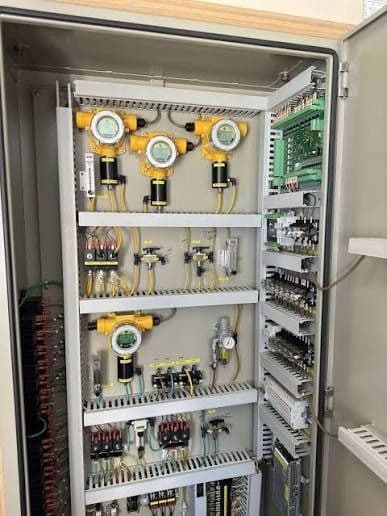
Cabinet of gas detectors and controllers
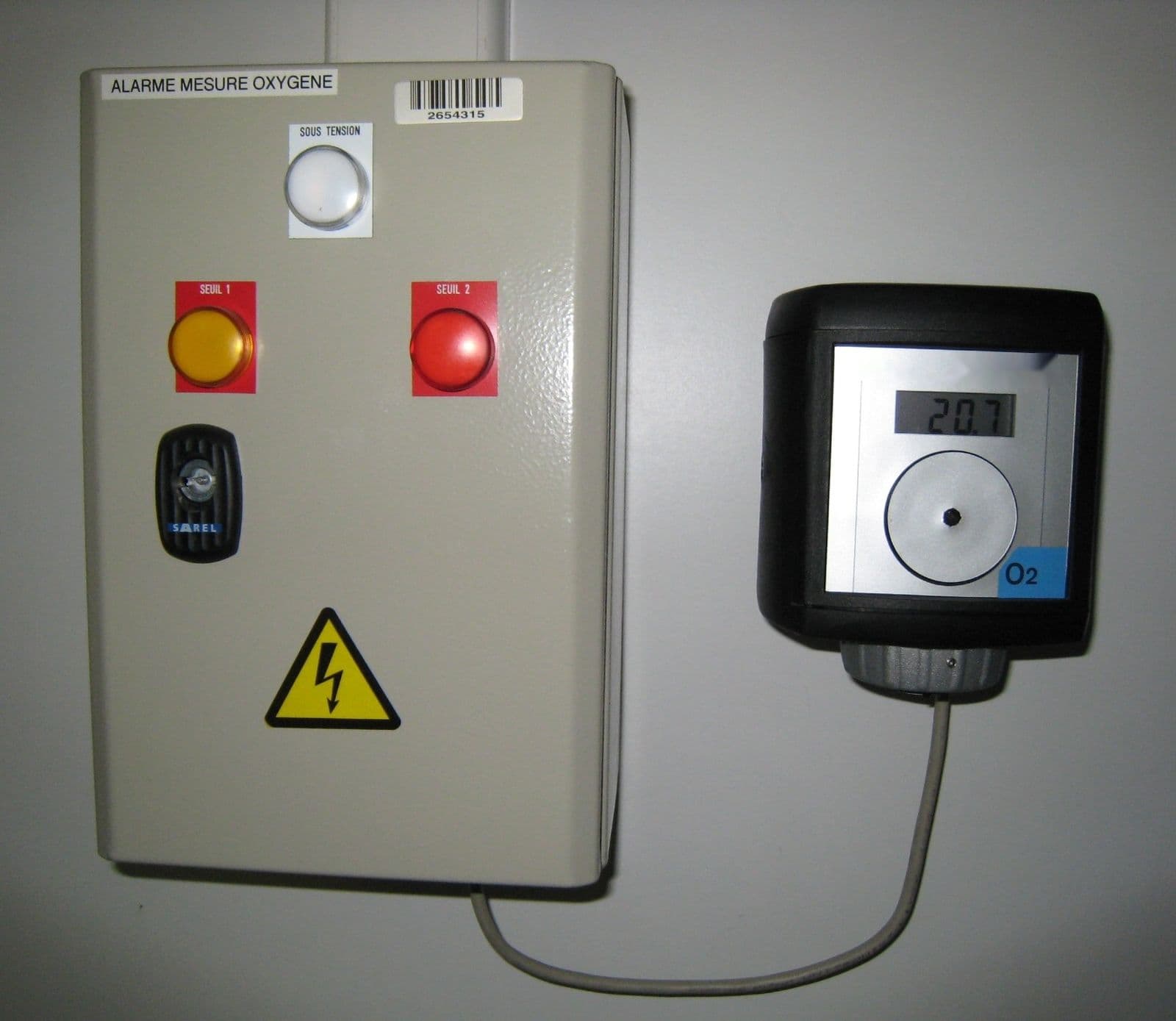
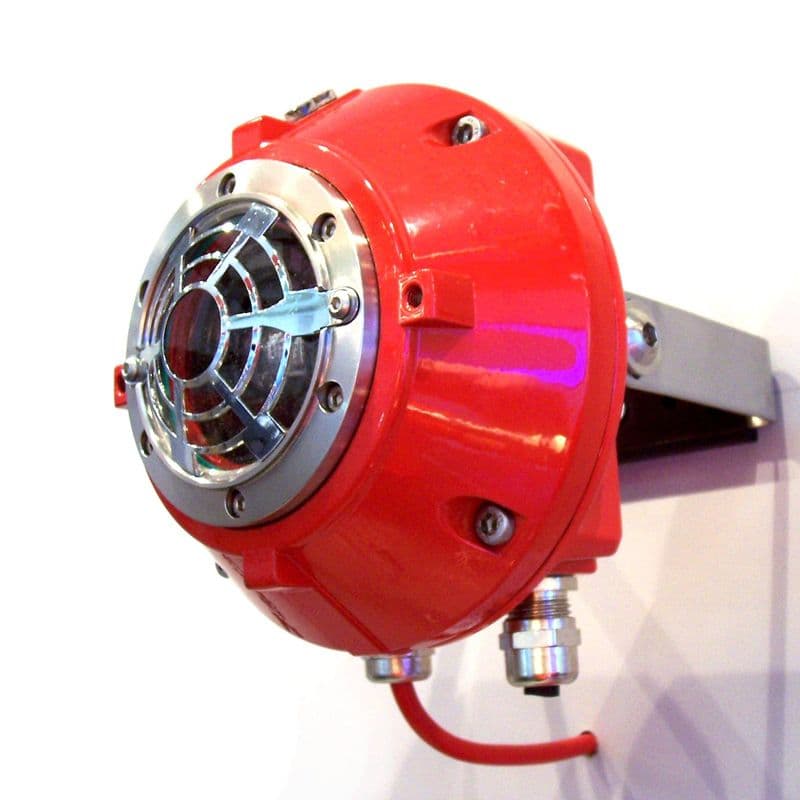
Fixed gas detector wired to a two-level alarm panel


Why De’s Technico
2 installations on record
Our project record lists 2 gas detection system installations, from design through commissioning.
One contract, design to handover
A lump-sum turnkey scope on single-window responsibility: design, engineering, supply, installation and commissioning answer to one schedule.
In fire protection since 1988
More than 35 years of designing and executing fire detection and protection systems for high-hazard industry.
Detection and suppression together
Gas detection designed with the fire detection and suppression it works beside, under one contract.
Questions we are asked
What is %LEL?
The concentration of a flammable gas as a percentage of its lower explosive limit — the leanest mixture that can burn. Detection acts at a small fraction of it.
Where should gas detectors go?
Near likely leak sources and where gas would collect: low down for gases heavier than air such as LPG, high up for lighter ones such as hydrogen and methane.
Point or open-path detectors?
Point detectors measure at one spot; open-path detectors watch a beam across a whole area or boundary. Many sites use both.
How often do detectors need calibration?
As the manufacturer sets, commonly every six months, with bump tests in between to confirm each detector still responds.
What happens when gas is detected?
Usually two stages: a first alarm to warn and investigate, and a second that triggers isolation, ventilation or shutdown automatically.
Related systems
Considering us for a turnkey scope?
Send the hazard, the code and the site. Our engineers reply with a scheme and a price.