
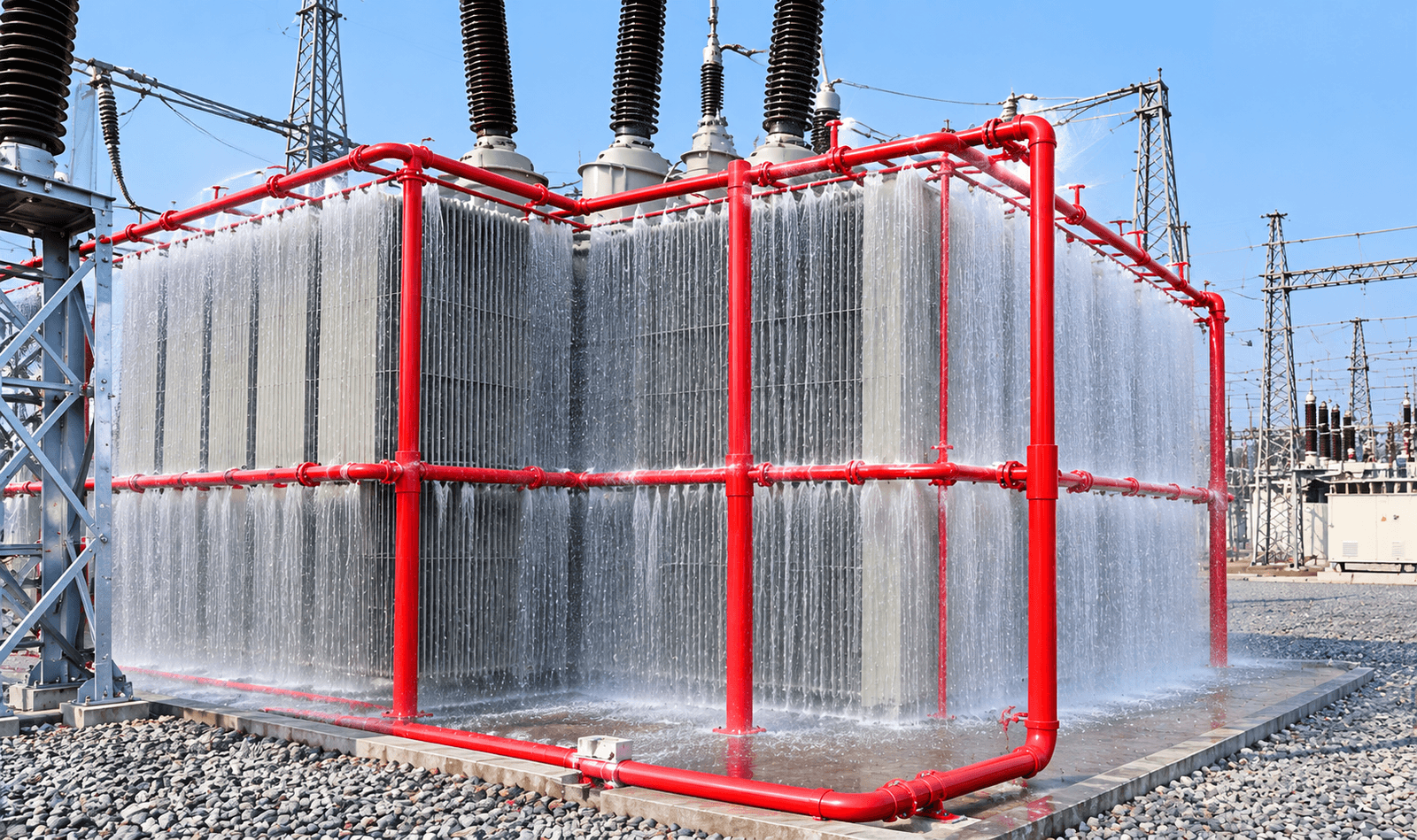
Water Curtain System
A continuous sheet of spray that shields walls, openings and neighbouring plant from radiant heat, holding a fire on one side of a boundary.
At a glance
- Governing standard
- NFPA 15
- Designed to
- NFPA 15
- Equipment source
- Our own works
How it works

A water curtain is a vertical sheet of spray used to separate one area from another: to protect a wall or an opening from radiant heat, or to hold a fire on one side of a boundary long enough for people to leave and for other systems to work.
It is an exposure protection measure rather than an extinguishing one. The nozzles are spaced and angled so their patterns overlap into a continuous sheet with no gaps, and the supply has to hold that pattern for the duration the separation is required.
Main components
- The water supply and a deluge or manual control valve.
- The curtain header along the line to be protected.
- Curtain nozzles producing flat, overlapping fan patterns.
Testing and maintenance
- Run a full-flow test and walk the line to confirm the sheet has no gaps.
- Clear any blocked nozzle, and check that new structures have not been built into the curtain line.
Scope we take
- 1
Design
The curtain line, nozzle type and spacing for a continuous sheet with no gaps, application rate and duration.
- 2
Supply
Curtain nozzles, the deluge valve set and pipework.
- 3
Installation
Pipework and nozzles along the line to be protected, with the valve set and its release.
- 4
Testing
Hydrostatic test and flushing.
- 5
Commissioning
A full-flow test to confirm the curtain forms a continuous sheet along its whole length.
- 6
Handover
As-built drawings, test records and operating and maintenance manuals, with training for the people who will run the system.
Equipment used
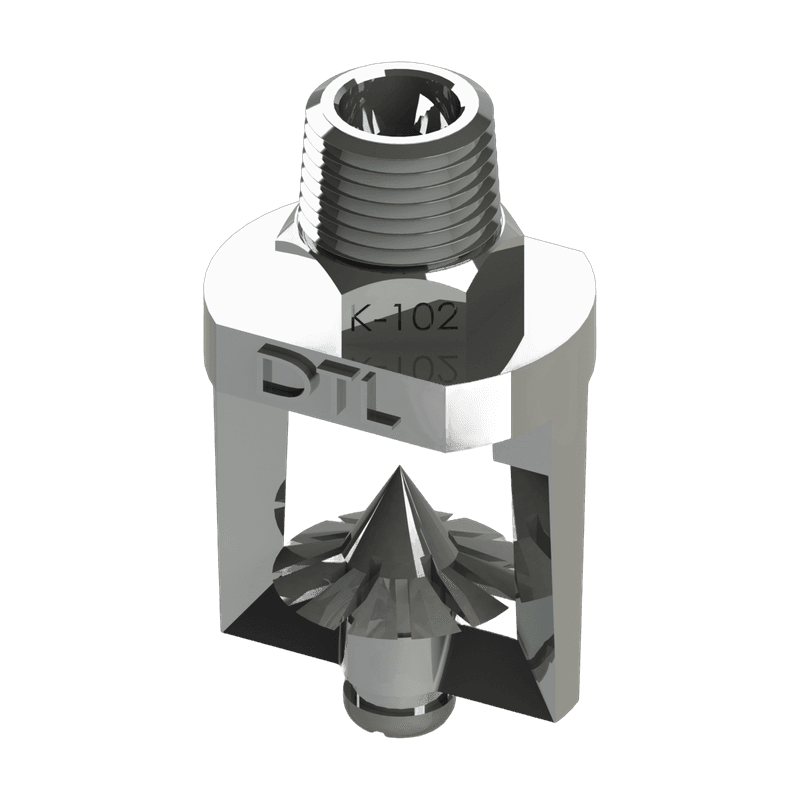

MVWS Nozzle Stainless Steel
Stainless steel 316, K-18 to K-102, 65° to 160°
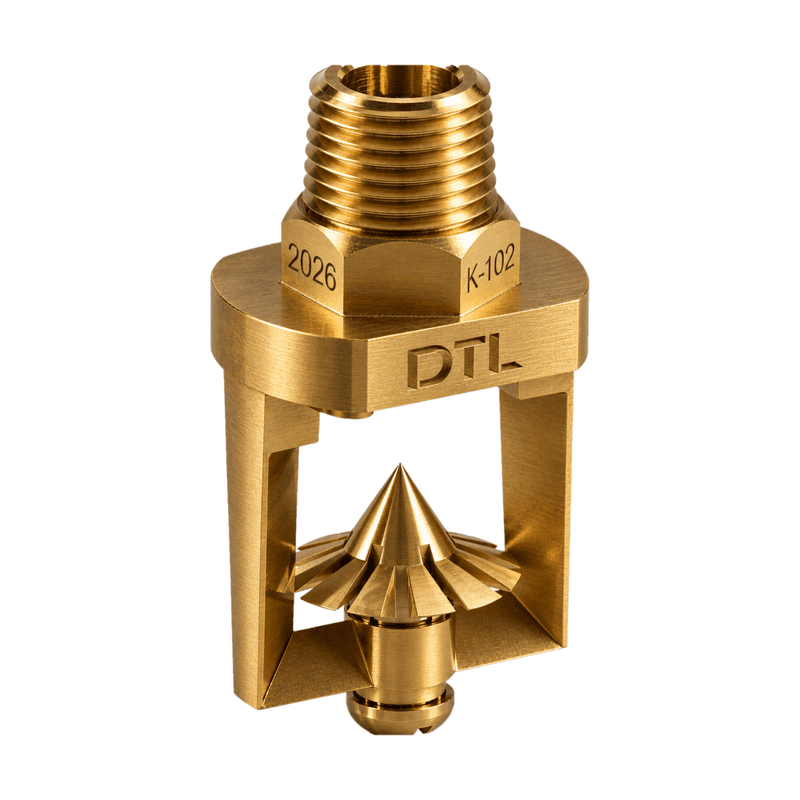
MVWS Nozzle Brass
Brass, K-18 to K-102, 65° to 160°
MVWS Nozzle
Brass or stainless steel 316, K-18 to K-102
Standards
- NFPA 15Water spray fixed systems, including curtain applications.
| Parameter | Figure | Source |
|---|---|---|
| Minimum pressure at any nozzle | 1.4 bar (20 psi), unless the nozzle is listed for less | NFPA 15 |
| Application rate | Set by the radiant heat the curtain must block — no single code figure; established in the design | NFPA 15 — performance based |
Service and maintenance
A fire protection system only performs if it is kept in the condition it was commissioned in. Inspection, testing and maintenance to the intervals the code sets — under an annual maintenance contract or as a single visit.
| Task | Interval | Reference |
|---|---|---|
| Inspect nozzles and the curtain line for blockage and new obstructions | Quarterly | NFPA 25 |
| Full-flow test, walking the line to confirm a continuous sheet | Annually | NFPA 25 |
Where it applies
Images · 2
Water curtain discharging around a transformer
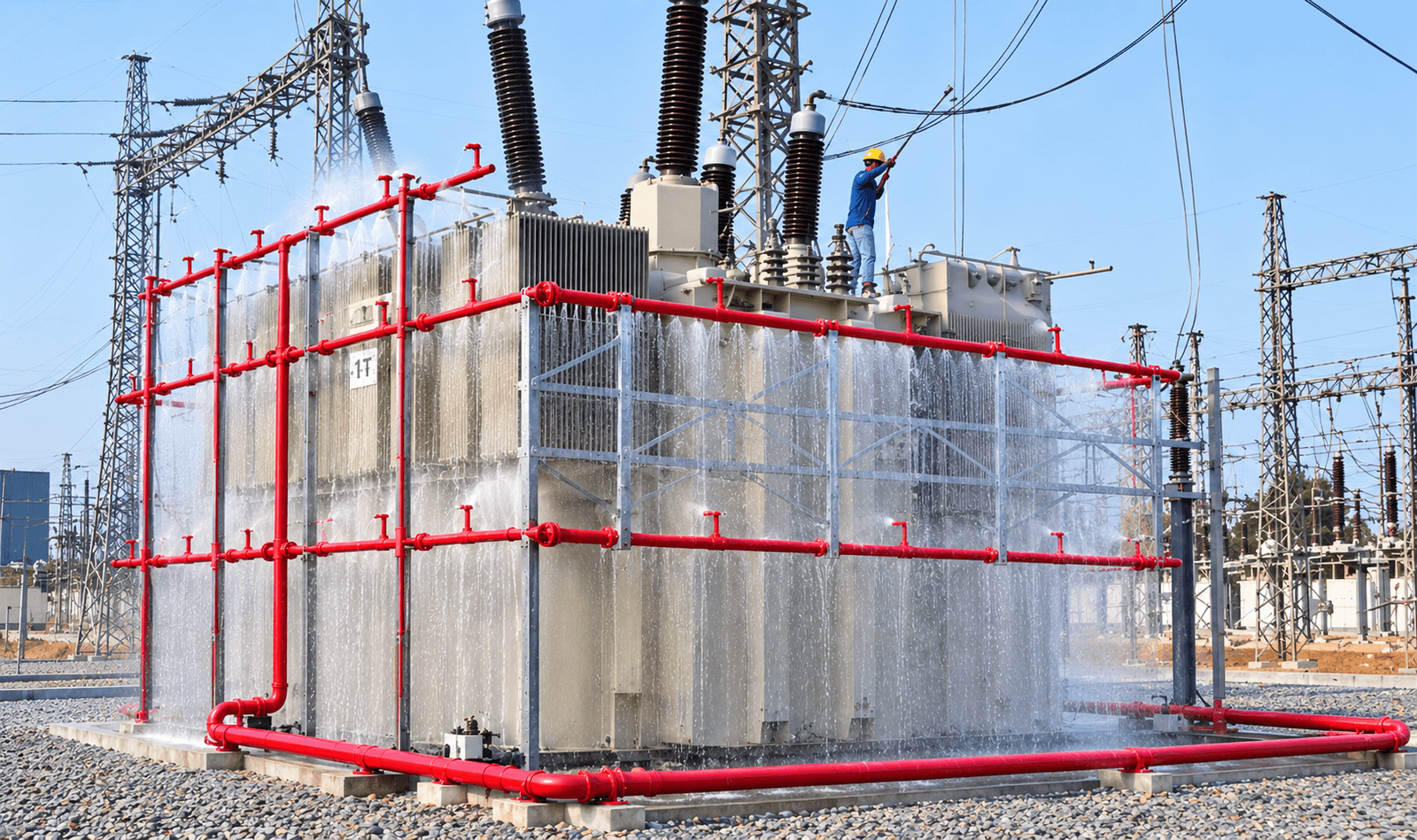
Water spray protection over a transformer


Why De’s Technico
Equipment from our own catalogue
MVWS spray nozzles are made in our own works, so supply and execution answer to one schedule.
One contract, design to handover
A lump-sum turnkey scope on single-window responsibility: design, engineering, supply, installation and commissioning answer to one schedule.
Built and tested in our works
Manufactured in two factory units of 48,000 and 30,000 sq ft, with in-house testing before despatch.
In fire protection since 1988
More than 35 years of designing and executing fire detection and protection systems for high-hazard industry.
Questions we are asked
Does a water curtain put the fire out?
No — it is exposure protection. It blocks radiant heat so a fire stays on one side of a boundary while other systems deal with it and people leave.
Where are water curtains used?
Around LPG spheres and bullets, at loading gantries, between transformers and across openings in fire walls.
How are the nozzles arranged?
Spaced and angled so their fan patterns overlap into one sheet with no gaps along the whole line.
How is it tested?
With a full-flow test, walking the line to confirm the sheet is continuous and no nozzle is blocked.
Is it released automatically?
It can be, through a deluge valve and detection, or manually where the operator decides when to deploy it.
Related systems
Considering us for a turnkey scope?
Send the hazard, the code and the site. Our engineers reply with a scheme and a price.