
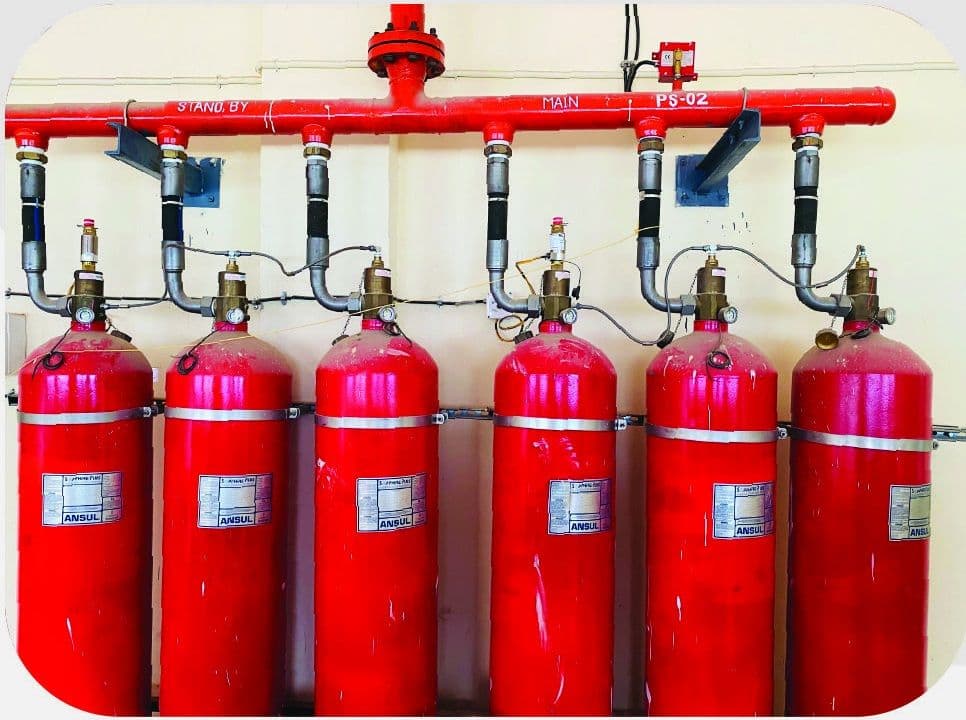
Clean Agent Fire Suppression
Inert or chemical agent discharged from a cylinder bank floods an enclosure in seconds and leaves no residue — for control rooms, server rooms and archives where water would do the damage.
At a glance
- Governing standard
- NFPA 2001
- Designed to
- NFPA 2001, ISO 14520, IS 15493
How it works

Clean agent systems protect enclosures where water would destroy what it is meant to save — control rooms, switch rooms, server halls, archives. The agent is discharged from a stored-pressure cylinder bank through a fixed pipe network, floods the enclosure to a design concentration within seconds, and leaves no residue.
Inert gas agents work by reducing oxygen below the level that supports combustion while staying breathable long enough for escape; chemical agents absorb heat. Either way the enclosure has to hold the concentration for the specified hold time, so room integrity — dampers, door seals, cable penetrations and pressure relief — is as much a part of the design as the cylinders.
Main components
- Agent cylinders with valves and actuators, and the manifold.
- The pipe network and discharge nozzles.
- Detection, usually two zones that must both alarm before release.
- A release panel with pre-discharge alarm, time delay, abort and manual release, and warning signs at the doors.
Testing and maintenance
- Check cylinder weight or pressure at the intervals the code sets.
- Repeat the enclosure integrity test whenever the room is altered, and at least as often as the code requires.
- Test detection, the release sequence and every interlock without discharging agent.
| Aspect | Inert gas (IG-541, IG-55, IG-01) | Halocarbon (HFC-227ea, FK-5-1-12) |
|---|---|---|
| How it extinguishes | Lowers oxygen below what combustion needs | Absorbs heat from the flame |
| Storage | Gas at high pressure | Liquid, super-pressurised with nitrogen |
| Discharge time | 60–120 seconds | 10 seconds |
| Storage space | More cylinders, which can sit further away | Compact, close to the room |
| Occupied spaces | Yes, at design concentration | Yes, within the agent’s safe exposure limit |
Scope we take
- 1
Enclosure survey
Room volume, openings and leakage paths, contents, ventilation and ambient temperatures.
- 2
Design
Agent selection, design concentration and quantity, nozzle layout and a flow calculation that proves discharge time.
- 3
Supply
Agent cylinders and valves, manifold, nozzles, and the detection and release panel.
- 4
Installation
Cylinder bank, pipe network, nozzles, detection and the release and abort controls.
- 5
Enclosure integrity test
A door fan test to confirm the room will hold the agent at concentration for the hold time.
- 6
Commissioning
Detection, release sequence and interlocks tested — ventilation shutdown, dampers, door holders and warning signs.
- 7
Handover
As-built drawings, test records and operating and maintenance manuals, with training for the people who will run the system.
Equipment used
Brands we supply and integrate

Standards
- NFPA 2001Clean agent fire extinguishing systems.
- ISO 14520Gaseous fire-extinguishing systems.
- IS 15493Gaseous fire extinguishing systems — general requirements.
| Parameter | Figure | Source |
|---|---|---|
| Discharge time, halocarbon agents | 10 seconds | NFPA 2001 |
| Discharge time, inert gas agents | 60 s (Class B), 120 s (Class A and C), to 95% of design concentration | NFPA 2001 |
| Design concentration | Extinguishing concentration × 1.2 (Class A) or × 1.3 (Class B) | NFPA 2001 |
| Hold time | At least 10 minutes, or as the authority requires | NFPA 2001 |
Service and maintenance
A fire protection system only performs if it is kept in the condition it was commissioned in. Inspection, testing and maintenance to the intervals the code sets — under an annual maintenance contract or as a single visit.
| Task | Interval | Reference |
|---|---|---|
| Check cylinder weight or pressure | Six-monthly | NFPA 2001 |
| Test detection, release sequence and interlocks without discharge | Annually | NFPA 2001 / NFPA 72 |
| Enclosure integrity inspection | Annually, and after any alteration | NFPA 2001 |
| Hydrostatic retest of cylinders | When the statutory test falls due | Gas cylinder rules |
Where it applies
Image
Clean agent cylinders and discharge manifold installed in a plant room

Why De’s Technico
6 installations on record
Our project record lists 6 inert gas fire suppression installations, from design through commissioning.
Represented brands
Panels and field devices from the detection brands we represent, supplied, installed and integrated under the same contract as the suppression system.
One contract, design to handover
A lump-sum turnkey scope on single-window responsibility: design, engineering, supply, installation and commissioning answer to one schedule.
In fire protection since 1988
More than 35 years of designing and executing fire detection and protection systems for high-hazard industry.
Questions we are asked
Is a clean agent safe for people in the room?
Clean agents are used in occupied spaces at their design concentration, but a pre-discharge alarm and time delay are still provided so people leave before discharge.
Inert gas or chemical agent?
Inert gases need more storage space but leave the atmosphere breathable and have no environmental impact; chemical agents discharge faster from compact storage. The room, the space for cylinders and the client’s preference decide.
Why does the room need an integrity test?
The agent must stay at concentration for the hold time. A door fan test finds the leaks that would let it escape too soon.
Does the room need pressure relief?
Usually yes. Discharging agent into a sealed room raises or lowers its pressure; a relief vent sized to the discharge protects the walls and doors.
Will the agent damage the equipment?
No. Clean agents leave no residue and do not conduct electricity, which is why they protect control rooms, server rooms and archives.
Related systems
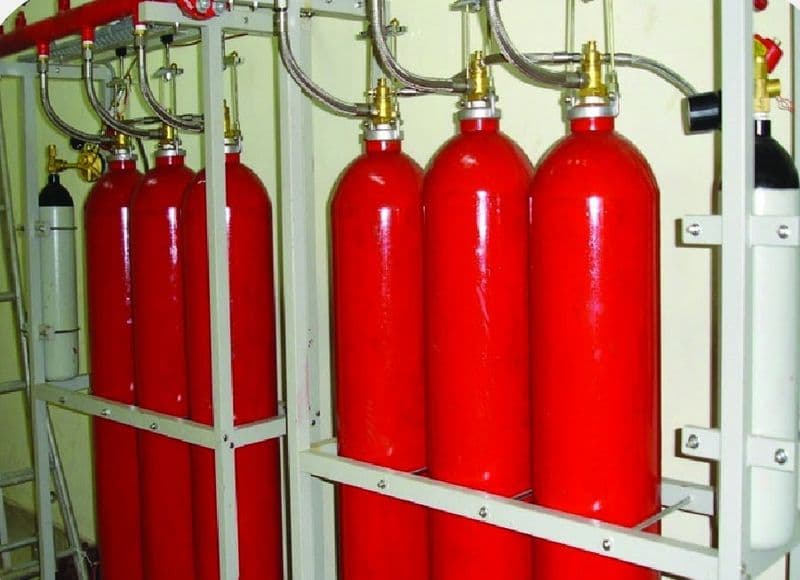 CO₂ Fire Suppression SystemTotal flooding carbon dioxide for unoccupied electrical and machinery spaces.
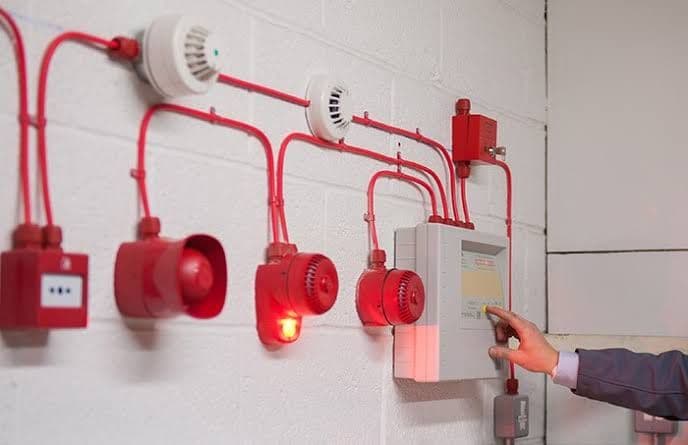 Fire Detection & Alarm SystemDetection and alarm, supplied and integrated under the same contract as the suppression system.
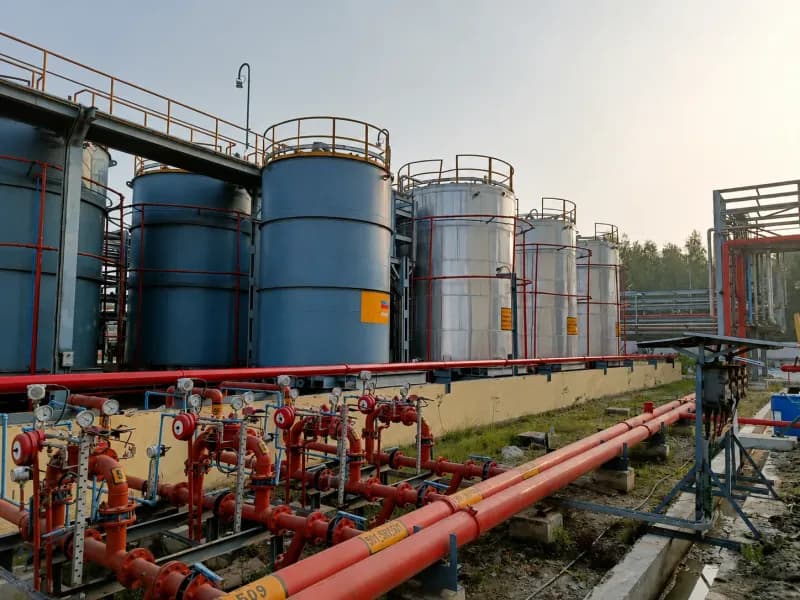 Fire Water Spray SystemMedium and high velocity spray for vessels, transformers and process equipment.
Considering us for a turnkey scope?
Send the hazard, the code and the site. Our engineers reply with a scheme and a price.